

 Mastering the Downward Flow:
Why Your Return Air Strategy is a Cleanroom Priority
By Jason Teets – General Manager, Performance Contracting
In the world of life science and pharmaceutical manufacturing, supply-side HEPA filtration and pressure differentials often steal the spotlight. However, a cleanroom is only as effective as its exhaust. While supply air brings in the clean, the return air strategy manages the dirty, serving as a fundamental safety barrier for both product and personnel.
Establishing a robust return air strategy is an important part of achieving and maintaining a room’s specific ISO classification.
The Low-Wall Advantage:
Controlling the Piston-Flow
In high-classification environments, air management must dilute contaminants and remove them efficiently. Traditional ceiling-level return grilles allow contaminants to spread throughout the room before being captured. Because many particulates naturally fall due to gravity, high-level returns increase the risk of product contamination.
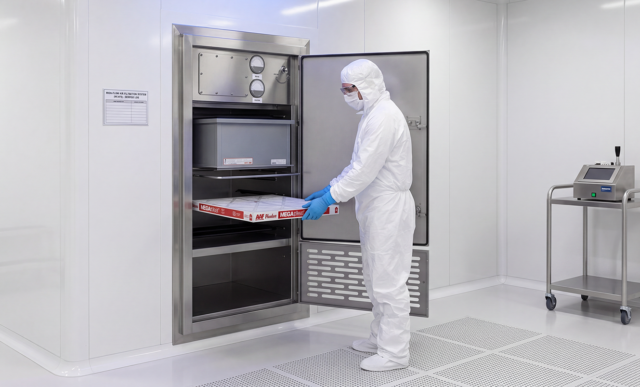
The solution is the Low-Wall Air Return System, which creates a unidirectional piston-flow pattern:
- Predictable Downward Sweep: Clean supply air acts as a piston, steadily pushing particulates toward the floor. This prevents the swirling effect often seen with ceiling returns, which keeps contaminants suspended in the ambient air.
- Minimized Cross-Contamination: By drawing air downward, particulates are captured before they can migrate laterally. This zonal control ensures that shedding from one operator doesn’t impact the cleanliness of an adjacent, sensitive work area.
- Optimized Recovery Rates: Low-wall returns eliminate stagnant dead zones. This allows the room to return to its validated cleanliness class much faster after a generation event, such as a shift change or minor spill.
Modular vs. Traditional:
The Chase for Integrity
Once you commit to a low-wall strategy, you have to decide how to move that air out. Your construction method usually dictates the path:
| Construction Method | The Approach | The Trade-Off | ||
| Stick-Built | Dedicated stainless or epoxy-coated ductwork is run behind traditional drywall studs. | PRO: Rugged, durable, and easy to inspect.
CON: Requires a larger physical footprint and often a longer installation timeline. |
||
| Modular Panels | The hollow cavity of the pre-engineered wall panel itself acts as the exhaust chase. | PRO: Saves significant floor space and accelerates schedules.
CON: Requires expert installers to ensure a 100% airtight seal. |
When Clean Becomes Contained:
The Two Faces of BIBO Strategy
It’s one thing to manage dust and skin cells to keep a product pure; it’s an entirely different challenge when the particles you’re moving are hazardous substances, potent compounds, or biological agents. In these environments, the return air strategy transitions from simple particulate control to strict containment.
When dealing with high-potency compounds, a Bag-In/Bag-Out (BIBO) system is non-negotiable for safe filter replacement. However, depending on your facility architecture, BIBO configurations generally fall into two distinct applications:
| Protection Function | The Application | How it Works |
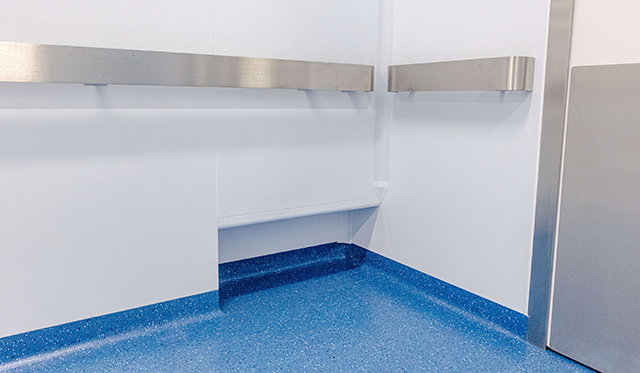
| In-Room Integrated Low-Wall Containment (Point-of-Origin Protection) | This approach utilizes specialized, integrated units where the low-wall return grille and the BIBO HEPA housing are designed as a single, combined system. | The filter is embedded directly into the low-wall space (typically 8–12 inches above the floor). This ensures hazardous particulates are captured and scrubbed immediately as they exit the room boundary, preventing contaminants from ever entering the exhaust ductwork. Because it is a BIBO unit, maintenance teams can perform side-access, zero-exposure filter changes right from within the conditioned cleanroom space. |
| Downstream Interstitial / Mechanical Containment (System-Level Protection) | This is the traditional setup where standard low-wall return grilles are used in the room, but the actual BIBO filtration housings are located further downstream, built into the air handling units or exhaust air banks. | Air is pulled out of the room and travels through the ductwork before reaching a centralized BIBO housing located in a remote mechanical room or interstitial space. This keeps maintenance activities entirely separate from the production suite, though it requires careful validation and duct-cleaning protocols since the upstream infrastructure is exposed to the raw exhaust air. |
 The Bottom Line
BIBO is not a single product type, it’s a containment philosophy. Whether you integrate BIBO housings directly into your low-wall panels for room-level isolation, or place them downstream in a remote mechanical room, the goal remains the same: ensuring that dangerous contaminants are never released into the facility or breathed in by technicians during a filter swap.
Whether you are protecting a sterile injectable from operator-shedded particulates or safeguarding a technician from a high-potency compound, your return air strategy is the operational backbone of a compliant facility. While standard ceiling returns may offer lower upfront capital costs, the long-term risk of a batch failure, validation delay, or containment breach far outweighs the initial savings.


January 5, 2026